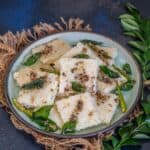
Rava Dhokla Recipe (Suji Dhokla)
Rava Dhokla is a Gujarati snack prepared with semolina, yogurt, and other ingredients. Serve it with green chutney and masala chai.
Servings: 6 people
Ingredients
For The Dhokla
- 1 cup fine semolina (rava, sooji)
- ½ cup plain yogurt (dahi, curd)
- 1 teaspoon green chili paste
- 1 teaspoon grated ginger
- 1 teaspoon granulated white sugar
- ½ teaspoon salt
- ¼ cup water
- 1 teaspoon lime juice
- 1 teaspoon oil
- 1 teaspoon ENO fruit salt
For The Tempering
- 1 tablespoon oil
- ½ teaspoon black mustard seeds
- 1 teaspoon white sesame seeds (til)
- 2-3 green chillies slit into half
- 10-12 curry leaves
- ¼ teaspoon asafetida (hing)
Instructions
Make The Batter
- Grease an 8-inch steamer plate and keep it aside.
- Mix fine rava, yogurt, chili paste, grated ginger, sugar, salt, and water in a bowl to make a lump-free mixture.
- Cover and keep aside for 20 minutes. This is the step not to rush. The semolina needs time to soak up the liquid; otherwise, your dhokla will taste grainy instead of soft, no matter how well you steam it.
- Once the semolina is soaked, add 2-3 tablespoons of water and make an idli-like batter.
- Add lime juice and oil and mix well.
Steam The Batter
- Heat 1 cup of water in the inner pot of the steamer over medium-high heat. Get this going before you touch the Eno. A cold steamer is one of the more common reasons dhokla doesn’t rise well, since the batter sits around, losing its bubbles, while the water heats up.
- Add ENO to the dhokla batter and mix well gently, just enough to combine. A few gentle folds are genuinely all it needs.
- Pour the batter into the prepared plate and spread evenly.
- Keep the steamer plate inside the steamer and close the lid.
- Steam at medium-high heat for 12-15 minutes or until a toothpick inserted in the center of the dhokla comes out clean.
- Remove the dhokla from the steamer and let it cool down for 10 minutes.
- Cut the dhokla into square pieces using a sharp knife. Give it the full 10 minutes of cooling first; cut too early, and the pieces will crumble instead of holding their shape.
Temper The Dhokla
- Heat oil in a small pan over medium-high heat.
- Add mustard seeds, sesame seeds, green chilies, curry leaves, and asafetida to hot oil and let them crackle for 4-5 seconds.
- Pour the tempering over the dhokla. Transfer the pieces to a serving plate and serve. You can also garnish the dhokla with some chopped coriander leaves.
Video
Notes
You can adjust the amount of green chili paste to your taste.
If ENO is unavailable, use an equal amount of baking soda. Add 1 teaspoon of lime juice per teaspoon of baking soda to give it an acidic taste similar to ENO.
I made this recipe in an 8-inch steamer plate, but any size works; the cooking time will vary accordingly. A smaller plate means a thicker layer of batter, which takes longer to steam through. If you want a thicker dhokla on purpose, you can double the batter in the same plate; just make sure the sides are tall enough to hold the extra height.
Nutrition
Calories: 150kcal | Carbohydrates: 23g | Protein: 4g | Fat: 4g | Saturated Fat: 1g | Polyunsaturated Fat: 1g | Monounsaturated Fat: 2g | Trans Fat: 0.01g | Cholesterol: 3mg | Sodium: 254mg | Potassium: 86mg | Fiber: 2g | Sugar: 2g | Vitamin A: 84IU | Vitamin C: 36mg | Calcium: 38mg | Iron: 1mg
