
Whole Spices In Indian Food: Do I Remove Them Before Serving?

This post may contain affiliate links. Please read our privacy policy.
You made an Indian curry. It smells incredible. You ladle it onto your plate, take a bite, and crunch, there’s a hard little brown thing in your mouth that tastes like a campfire wrapped in perfume. Welcome to the cardamom pod.
If you’ve ever cooked from an Indian recipe and wondered, “Wait, am I supposed to fish all of this out before I serve it?” congratulations, you’ve hit one of the most common questions new Indian home cooks ask. And the answer is: it depends, but probably not, and here’s how to handle it like a normal person.
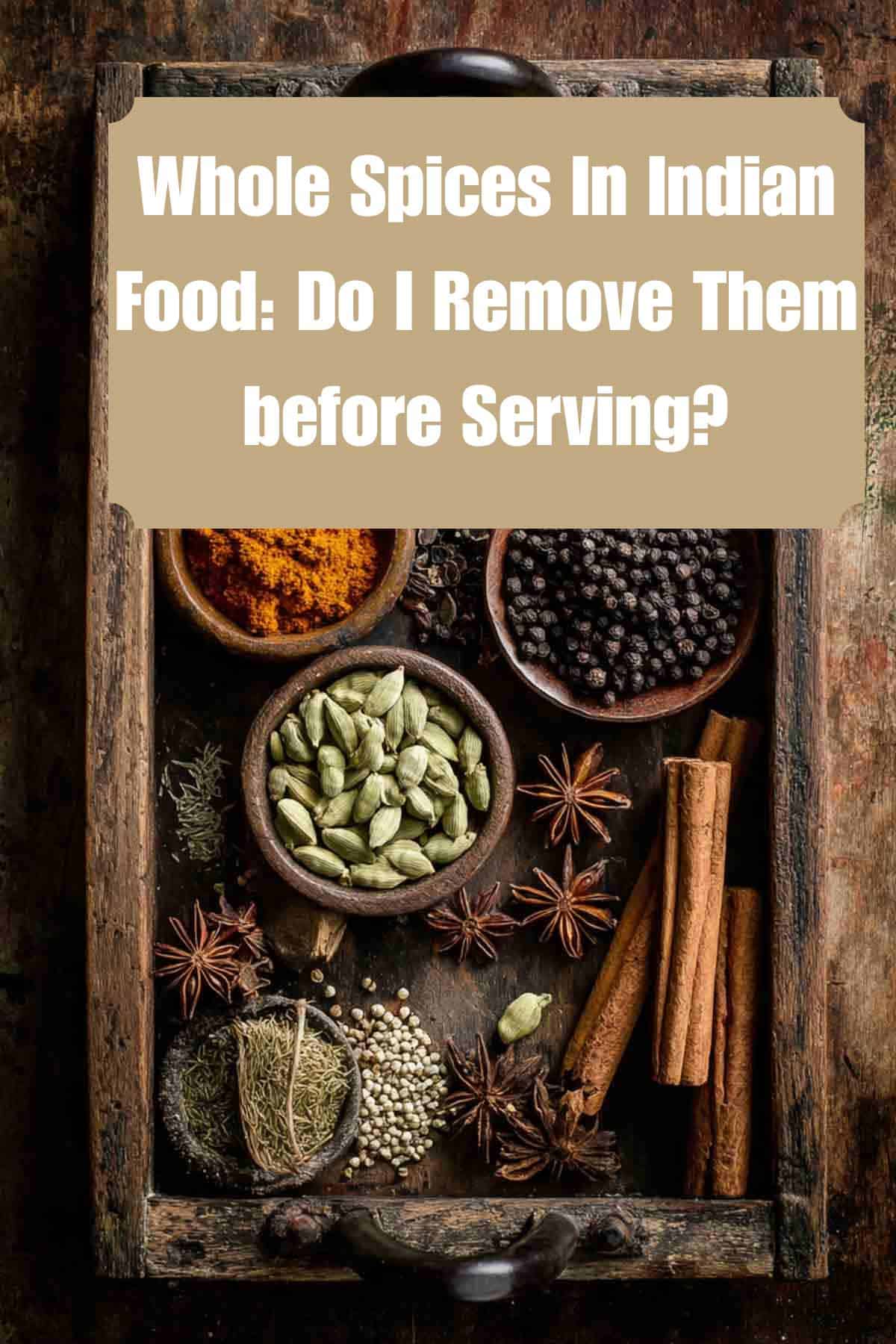
Table of Contents
The Short Version
You have three reasonable options:
- Leave the spices in and warn people. Tell your guests there are whole spices floating around and to push them to the side of the plate as they eat.
- Pick them out before serving. Count what went in (3 cloves, 2 bay leaves, 1 cinnamon stick, 4 cardamom pods) and pull out the same number at the end.
- Cage them while cooking. Tie the whole spices in cheesecloth, drop them in a tea infuser, or use a stainless steel spice ball. The flavor gets out, the spices stay contained, and you lift the whole thing out before serving.
That’s it. That’s the post. If you want the longer version with the reasoning, keep reading.
Why Are The Whole Spices Even In There?
This is the question worth answering, because once you understand it, the rest no longer feels weird.
When you bloom whole spices in hot oil or ghee at the start of a dish, a technique called tadka or tarka, you’re pulling fat-soluble flavor compounds out of the spices and infusing them into the oil itself. That oil then carries flavor through the entire dish. Whole spices release this flavor slowly and gently, which is why a long-simmered biryani or a slow-cooked goat curry wants whole cinnamon and cloves instead of ground.
Ground spices behave completely differently. They release flavor quickly, can turn bitter if cooked too long, and thicken sauces. They’re not interchangeable. A recipe that calls for whole cardamom is not asking you to substitute a pinch of ground cardamom, which will give you a different dish, often a worse one.
So the whole spices are doing a job. The question isn’t whether to use them. It’s what to do with them once they’ve finished their job.
The Spices You Should Not Eat (Or At Least, Don’t Have To)
These are the big offenders, the ones that taste fine in the dish but unpleasant if you bite straight into one:
- Cinnamon sticks: Easy to spot, easy to remove
- Bay leaves: Leathery, sharp-edged, please don’t swallow these whole
- Star anise: Gorgeous, but hard as a rock
- Black cardamom pods: The big smoky ones, way too intense to crunch
- Green cardamom pods: Small enough to hide; the most common surprise bite
- Cloves: Tiny dark nail-shaped things, the absolute worst to bite into, will numb your tongue
- Dried red chilies (whole): Depending on your tolerance, most people set them aside
The Spices You Can Absolutely Eat
These are usually small, soft enough to chew, and meant to be eaten:
- Cumin seeds
- Mustard seeds
- Fennel seeds
- Coriander seeds
- Nigella seeds (kalonji)
- Black peppercorns (some people set these aside, but they’re fine to eat)
- Curry leaves (small fresh ones, yes; tough dried ones, eh)
If it’s small and has softened by the cooking liquid, it’s almost certainly meant to stay.
So Which Method Should You Actually Use?
Here’s my honest take after years of cooking this stuff:
For weeknight family meals, leave the spices in. Everyone learns. Kids learn fastest, actually. One bite into a clove and they develop spice radar for life. There’s a reason nearly every Indian adult can spot a cardamom pod in a forkful of rice from across the table.
For dinner parties with guests new to Indian food, use the cheesecloth or tea infuser trick. It’s the path of least friction. No one has to perform spice surgery on their plate while trying to make conversation, and you don’t have to give a five-minute briefing before serving.
For something like biryani, where the whole spices are deeply embedded in layered rice and impossible to fish out, just warn people. A quick “heads up, there are whole cloves and cardamom in here, just push them to the side if you find one” is all it takes. Most people are fine with this. The ones who weren’t probably wouldn’t have enjoyed biryani anyway.
A Few Things Not To Do
Don’t skip the whole spices. I know it’s tempting. Don’t. The recipe will not taste right.
Don’t substitute ground for whole one-to-one. Different chemistry, different result. If you genuinely cannot deal with whole spices, find a recipe written for ground spices from the start rather than swapping them in a recipe designed around whole.
Don’t use cheap paper teabags meant for tea. They can fall apart during long simmering, and many are made of plastic. Use cheesecloth, a stainless steel spice ball, or a proper muslin spice bag.
Don’t grind your whole spices to powder, thinking that solves the problem. It changes the flavor profile entirely and can make the dish bitter or muddy.
The Mindset Shift
Eating Indian food with whole spices in it is a small skill. It takes about two meals to learn. You start scanning your bites, you learn the shapes by feel, and after a while, you don’t even think about it; you just nudge the cinnamon stick to the rim of your plate the same way you’d set aside a chicken bone or an olive pit.
It’s not a flaw in the cuisine. It’s a cooking technique that’s been refined over centuries to extract the maximum flavor from a handful of dried bark, seeds, and pods. The whole spice on your plate is the recipe for everything good in your bowl.
So leave them in, take them out, cage them in cheesecloth, whatever works for the meal you’re cooking and the people you’re feeding. Just don’t skip them.