
Kerala-Style Varutharacha Sambar Recipe

This post may contain affiliate links. Please read our privacy policy.
Rich, aromatic, and full of authentic South Indian flavors, varutharacha sambar is made with freshly roasted spices and coconut ground into a flavorful paste. This traditional Kerala-style sambar pairs beautifully with rice, idli, or dosa and is sure to become a family favorite!

Table of Contents
My everyday sambar starts with a jar of homemade sambar powder. This varutharacha sambar doesn’t. I roast coconut, coriander seeds, and curry leaves in hot coconut oil, grind them fresh, and for the next few hours, my kitchen smells like a Kerala home lunch.
I first fell for coconut-based sambar during my years in Bengaluru, where South Indian meals were simply part of the week. The Kerala version stood out. It was nuttier, a little thicker, and packed with vegetables instead of just one or two.
At home now, this is my weekend pot. I make it in my 3-quart Instant Pot, and the vegetables cook right in the dal with the roasted masala. One pot, about an hour, and lunch is sorted for two days.
What Is Varutharacha Sambar?
In Kerala, sambar isn’t one dish. Every region, and almost every home, has its own way, with or without coconut. Varutharacha is the richest of them.
Varutharacha Sambar is a Kerala-style sambar made with a paste of coconut, lentils, and whole spices roasted in coconut oil and freshly ground.
Varutharacha means “roasted and ground” in Malayalam. The roasted coconut gives it a nutty, deep flavor and a thick body, and it’s a must on the Onam sadya, Kerala’s festive vegetarian feast served on a banana leaf.
Here’s what sets it apart:
- Roasted coconut. Grated coconut is roasted with chana dal, urad dal, coriander seeds, fenugreek, and dry red chilies in coconut oil, then ground into a paste. That roasting is the “varuthu” in varutharacha.
- Coconut oil. It’s used for the masala and the tadka (hot oil tempering poured on at the end), which gives the dish its Kerala aroma.
- Many vegetables at once. Drumsticks, pumpkin, brinjal, carrots, and potatoes all go in together and cook right in the masala.

Other Kerala Sambar
You’ll find a few other styles across Kerala. Here are ulli sambar, malabar sambar, pacha sambar, varathuracha, and everyday sambar. Some homes grind fresh coconut with the spices without roasting it, which gives a lighter, paler sambar. Others skip coconut completely and make a thinner everyday sambar with sambar powder, much like my classic sambar served with idli and dosa. And around Palakkad, many families make varutharacha without onion, the way it’s served in temple feasts. Roasted coconut is what makes this version the one you’ll see on a sadya leaf.
Ingredients
For The Sambar
- Toor Dal – They give sambar its body. Yellow moong dal or pink masoor dal work too.
- Mixed Vegetables – I use carrots (gajar), potatoes (aloo), brinjal (baingan), and yellow pumpkin (kaddu). Any firm vegetable works: white pumpkin, okra, bottle gourd, snake gourd, or green beans. In the US, kabocha or butternut squash stands in well for pumpkin.
- Drumsticks – They add a mild, grassy sweetness. Frozen drumsticks from the Indian store are fine.
- Tomatoes – Fresh tomatoes add a second layer of tang and some color.
- Tamarind Pulp – The main souring agent. Store-bought concentrate works; use a little less, since it’s stronger.
- Turmeric and Salt – Use turmeric powder for color and salt for taste.
For The Varutharacha Masala
- Coconut Oil – Use virgin or regular; either gives the Kerala flavor. Any neutral oil works, but you’ll miss some aroma.
- Chana Dal and Urad Dal – They add nuttiness and help thicken the curry.
- Fenugreek Seeds – A little brings depth. Too much or burnt, and they turn bitter.
- Coriander Seeds – The main spice in the paste.
- Dry Red Chilies – Kashmiri chilies give color with less heat; regular dry chilies give more bite.
- Asafoetida (Hing) – A pinch adds a savory, oniony note. Skip it to keep the dish gluten-free, since most hing is cut with wheat flour.
- Onions – They add body and a soft sweetness.
- Curry Leaves – Fresh leaves only; dried ones have little flavor.
- Fresh Coconut – Frozen grated coconut, thawed, works perfectly. Desiccated coconut is a backup, but it browns faster, so watch it closely.
For The Tempering (Tadka)
- Coconut Oil, Black Mustard Seeds, Dry Red Chilies, and Curry Leaves – Black mustard seeds (rai) are popped in hot coconut oil with chilies and curry leaves. Add this last to wake up the whole pot.
How To Make Kerala-Style Varutharacha Sambar
Cook The Dal
Rinse the dal. Wash 1 cup toor dal 2–3 times until the water runs clear. This removes surface starch, so the dal doesn’t foam up.
Load the Instant Pot. Add the dal, 2 cups water, 2 teaspoons salt, and 1 teaspoon turmeric powder to a 3-quart Instant Pot. Stir gently.

Pressure cook. Close the lid, set the valve to Sealing, and Pressure Cook on High for 10 minutes.

Release and mash. Let the pressure release naturally for 10 minutes, then release the rest manually. Mash the dal with the back of a ladle. It should look like the photo below. Soft enough to fall apart, with no whole grains left.
On the stovetop: In a 3.5-4 liter pressure cooker, cook for 1 whistle on high heat, then 10 minutes on low. Use 3 cups of water instead of 2 cups.

Make The Varutharacha Masala
Start this while the dal cooks.
Fry the lentils. Heat 3 tablespoons coconut oil in a heavy pan over medium-high heat. Once the oil is hot, add 2 teaspoons chana dal and 2 teaspoons urad dal. Fry, stirring often, until golden brown. Keep stirring; the lentils go from golden to burnt in seconds.

Add the spices and onions. Add 1 teaspoon fenugreek seeds, 2 tablespoons coriander seeds, 5-6 dry red chilies, ½ teaspoon asafoetida, 1 cup sliced onions, and 15–20 curry leaves. Cook for 2–3 minutes until the onions soften, and the coriander smells toasty.

Roast the coconut. Stir in ½ cup grated fresh coconut and roast for another 2-3 minutes, stirring constantly, until it turns golden and smells nutty. This step matters, so don’t rush it or walk away. The coconut burns fast once it starts to color.

Cool and grind. Let the masala cool to room temperature. Then blend it with ½ cup water into a smooth paste. Grinding it hot builds steam in the jar, and the paste comes out grainy.

Cook The Sambar
Add the paste. Stir the masala paste into the cooked dal. Scrape the bottom of the pot well. The thick paste can settle and set off the BURN warning.

Add the vegetables. Add 4 cups mixed vegetables (cut into ½-inch cubes), the drumstick pieces, and 1 cup chopped tomatoes. Mix and close the lid. Cutting everything to ½ inch ensures everything cooks evenly.

Pressure cook again. Pressure Cook on High for 3 minutes. Let the pressure release naturally for 10 minutes, then release the rest and open the lid. This is where my method differs from most. Many recipes simmer the vegetables in the dal for 25 minutes. Here, they cook under pressure in the roasted masala itself, so they soak it up while still holding their shape.
On the stovetop: Pressure cook for 3 whistles on high heat.

Add tamarind and adjust. Stir in 3 tablespoons tamarind pulp. Add hot water if it’s thicker than you like. Taste, then add more salt or tamarind if needed.
The tamarind goes in last for a reason. I once added it with the vegetables before pressure cooking, and my potatoes and carrots came out firm. Acid slows how vegetables soften, so now I always add it after the pot opens.

Temper And Serve
Make the tadka. Heat 2 tablespoons coconut oil in a small pan over medium-high heat. Once the oil is hot, add 1 teaspoon black mustard seeds, 3-4 dry red chilies, and 12-15 curry leaves. Fry for 4-5 seconds, just until the seeds pop and the leaves crackle.

Finish. Pour the tadka over the sambar and mix well. Serve hot with steamed rice.

Pro Tips By Neha
- Roast by smell, not just time. The coconut is ready when it’s golden, and your kitchen smells nutty. Pale coconut gives a flat masala; dark brown turns bitter.
- Cover after the tadka. Close the lid for 5-10 minutes after pouring the tempering. The aroma stays in the sambar, not the kitchen.
- Soak the brinjal. Keep the cut brinjal in salted water until you need it. It stops browning and draws out bitterness.
- Balance, don’t chase. Tamarind, salt, and chili balance each other. If it tastes flat, add salt before you add more tamarind.
- Make extra paste. The roasted masala paste freezes well. Double it and freeze half in an ice cube tray for quicker sambar next time.
- Scaling up is easy. Double the recipe in a 6-quart Instant Pot or a bigger cooker. The cooking times stay the same.
Serving Suggestions
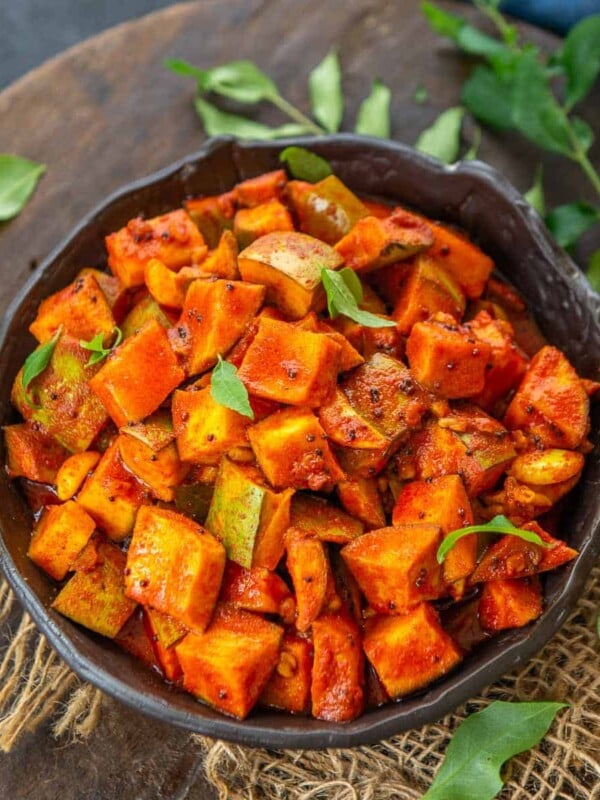
The classic way is steamed rice with a spoon of ghee and crisp pappadam. For a mini sadya at home, add pineapple pachadi, moru curry, and a spoon of Kerala mango pickle. On a real sadya leaf, sambar arrives in the second course, after the rice and the first round of side dishes (Kerala Tourism explains the full order).
This sambar is thick and rich, which is why it’s built for rice. For idli, dosa, or vada, my classic sambar is thinner and quicker. If you want this one at breakfast, loosen it with hot water and serve with coconut chutney on the side.
Storage Suggestions
Varutharacha sambar gets even better the next day as the roasted masala settles in.
Store leftovers in an airtight container in the fridge for up to 3 days. It thickens a lot when it cools, so add a splash of hot water when reheating. Warm it in a pan over medium heat until it bubbles.
You can freeze the cooked sambar without the tadka for up to 2 months, then thaw, reheat, and add a fresh tempering just before serving.
Varutharacha Sambar FAQs
It’s one kind of Kerala sambar. Other Kerala homes grind the coconut raw, or skip coconut and use sambar powder. Varutharacha is the roasted-coconut version served at sadya.
Varutharacha sambar uses a freshly roasted coconut-and-spice paste and coconut oil. Regular sambar, like my classic sambar, is built on sambar powder and has no coconut.
You can, but then it’s no longer varutharacha. For a powder-based version, follow my classic sambar, made with my homemade sambar powder.
Yes. Use a 6-quart Instant Pot or a larger stovetop cooker. The cooking times stay the same.
Other Kerala Recipes We Recommend

Craving more? Subscribe to Whisk Affair to get new recipes and a newsletter delivered straight to your inbox! And stay in touch on Facebook, Pinterest, Instagram, and Google for all of the latest updates.

Kerala-Style Varutharacha Sambar Recipe
Ingredients
For The Sambar
- 1 cup toor dal
- 1 teaspoon turmeric powder
- 2 teaspoons salt (or to taste)
- 4 cups mixed vegetables (I used a mix of carrots, potatoes, brinjal, and yellow pumpkin, cut into ½-inch cubes. and drumsticks cut into 2-inch pieces.)
- 1 cup chopped tomatoes
- 3 tablespoons tamarind pulp
For The Varutharacha Masala
- 3 tablespoons coconut oil
- 2 teaspoons chana dal
- 2 teaspoons white urad dal
- 1 teaspoon fenugreek seeds (methi dana)
- 2 tablespoons whole coriander seeds
- 5-6 whole dried red chilies
- ½ teaspoon asafetida (hing) (skip for gluten-free)
- 1 cup thinly sliced onions
- 15-20 curry leaves
- ½ cup grated fresh coconut
For The Tempering
- 2 tablespoons coconut oil
- 1 teaspoon black mustard seeds
- 3-4 whole dried red chilies
- 12-15 curry leaves
Instructions
Cook The Dal
- Wash the toor dal 2–3 times until the water runs clear.
- Add the dal, water, salt, and turmeric powder to a 3-quart Instant Pot. Stir gently.
- Close the lid, set the valve to Sealing, and Pressure Cook on High for 10 minutes.
- Let the pressure release naturally for 10 minutes, then release the rest manually. Mash the dal with the back of a ladle.
Make Varutharacha Masala
- Heat coconut oil in a heavy pan over medium-high heat. Once the oil is hot, add chana dal and urad dal. Fry, stirring often, until golden brown. Keep stirring; the lentils go from golden to burnt in seconds.
- Add fenugreek seeds, coriander seeds, dried red chilies, asafoetida, sliced onions, and curry leaves. Cook for 2–3 minutes until the onions soften, and the coriander smells toasty.
- Stir in grated fresh coconut and roast for another 2-3 minutes, stirring constantly, until it turns golden and smells nutty.
- Let the masala cool to room temperature. Then blend it with ½ cup of water into a smooth paste.
Cook The Sambar
- Stir the masala paste into the cooked dal. Scrape the bottom of the pot well. The thick paste can settle and set off the BURN warning.
- Add vegetables, the drumstick pieces, and tomatoes. Mix and close the lid.
- Pressure Cook on High for 3 minutes. Let the pressure release naturally for 10 minutes, then release the rest and open the lid.
- Stir in the tamarind pulp. Add hot water if it’s thicker than you like. Taste, then add more salt or tamarind if needed.
Temper And Serve
- Heat coconut oil in a small pan over medium-high heat. Once the oil is hot, add mustard seeds, dried red chilies, and curry leaves. Fry for 4-5 seconds, just until the seeds pop and the leaves crackle.
- Pour the tadka over the sambar and mix well. Serve hot with steamed rice.


















Fantastic….. since a long time was wanting to make sambhar Kerala style….since I have a Kerala connection, and being a gujju i’am a foodie to the core. Thank you very much for the recipe. 🙏🙏….. and by the way we are from the same profession……. except that i’am a dental technician.